





A new approach to digital eye strain
Long regarded as a purely ocular phenomenon, digital eye strain is now being viewed through a broader perspective.
Recent research has highlighted the existence of close interactions between visual and cognitive functions1,2,3. Attention, concentration, accommodation, and visual focus continuously engage the brain’s resources.
As visual effort is sustained over time, cognitive load increases. This overload may contribute to a vicious cycle involving visual fatigue, mental fatigue, and reduced cognitive performance.
The approach developed around RhodioZen® for eye health is based on this understanding of the eye–brain connection.
Diverse needs, one shared visuo-cognitive challenge

Connected Professionals
To support the demands associated with constant connectivity, cognitive workload, and digital fatigue.

Students
To help sustain concentration, memory, and mental endurance during intensive learning periods.

Athletes
To support performance in situations requiring sustained vigilance, focus, and decision-making under physical exertion.

Gamers
To address the demands on attention, responsiveness, and cognitive endurance during extended gaming sessions.
Our study
Can Rhodiola Rosea supplementation mitigate digital eye strain?
Lara PM, et al., Ophthalmic Physiol Opt. 2025 Nov;45(7):2054-2062. doi: 10.1111/opo.70005.
Randomized, triple-blind, placebo-controlled crossover study
18 volunteers, aged between 19 and 34 years
Supplementation intake
Monday
Tuesday
Wednesday
Cure : 2 × 600 mg / d
12h appart
Tests
Thursday
1200 mg intake 1h prior to the cognitive tasks
Wash Out
Friday
Saturday
Sunday
Evaluation
Cognitive tasks :
Stroop
Visual performance :
Dynamics of the accommodative response at two distances (40 cm and 20 cm).
DES questionnaire :
Digital Eye Strain
A significant improvement in accommodative stability
Accommodation refers to the eye’s ability to adjust its focus when shifting between different viewing distances.
An improvement in this function helps facilitate focus on nearby objects and reduces the associated visual effort.

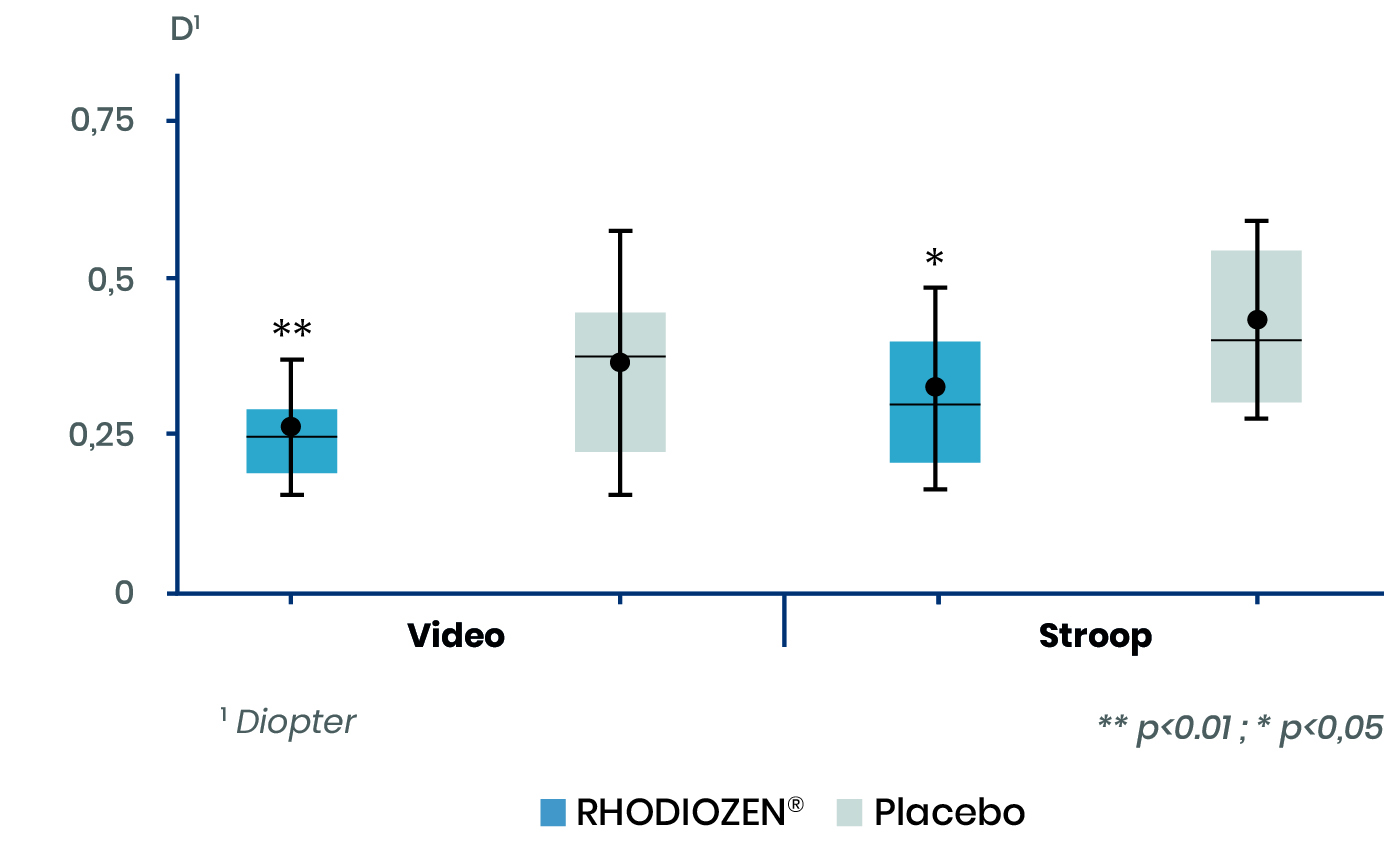
At a typical eye-to-computer viewing distance (40 cm), RhodioZen® reduced accommodative variability following cognitive tasks.

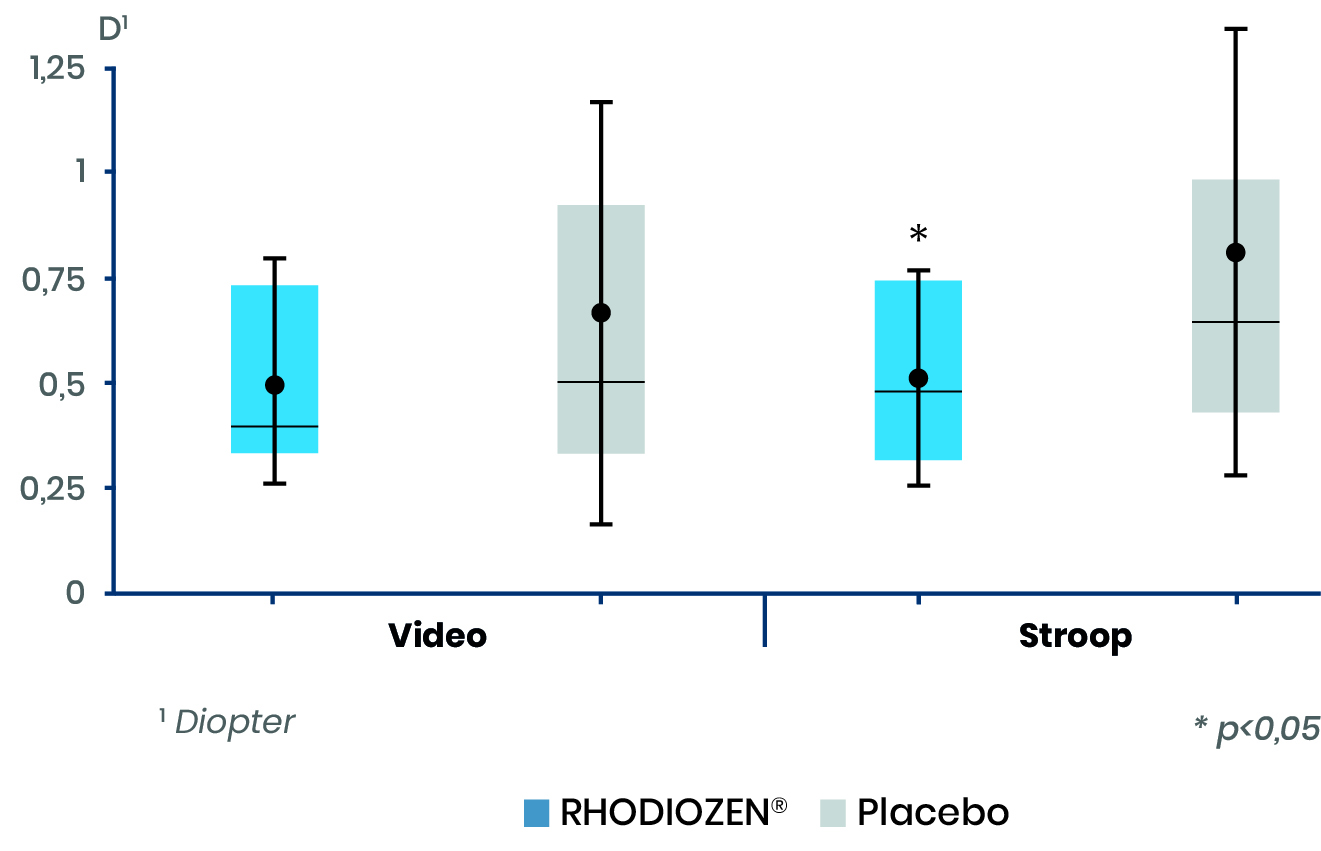
At a typical eye-to-smartphone viewing distance (20 cm), RhodioZen® reduced accommodative variability following the Stroop task.
Your questions answered
Can I use the study results for my dietary supplements?
The use of data generated from the study requires a co-branding agreement. This ensures compliant and authorized use of both the scientific findings and the registered RhodioZen® trademark.
When can RhodioZen® be used for eye health applications?
RhodioZen® is particularly relevant for individuals exposed to prolonged screen use and visual fatigue associated with cognitive workload.
Which populations can benefit from RhodioZen® for vision support?
Professionals with high cognitive demands and extensive screen exposure. Students and young adults who regularly use multiple digital devices. Athletes involved in cognitively demanding activities. Gamers, both recreational and professional.
At what dosage has RhodioZen® demonstrated efficacy for vision support?
Efficacy has been demonstrated with a sub-acute intake of 1,200 mg.
Our sources
- Manna P et al., Clin Optom (Auckl). 2026 Mar 3;18:586750. doi: 10.2147/OPTO.S586750.
- Gaume A et al., Cogn Neurodyn. 2019 Jun;13(3):257-269. doi: 10.1007/s11571-019-09521-4.
- Veldman MHJ et al., Optom Vis Sci. 2024 Nov 1;101(11):646-651. doi: 10.1097/OPX.0000000000002192
Convinced by RhodioZen®® ?
We remain at your disposal to send you the brochure, arrange a presentation, or answer any questions you may have.